 My Shop
 My Account
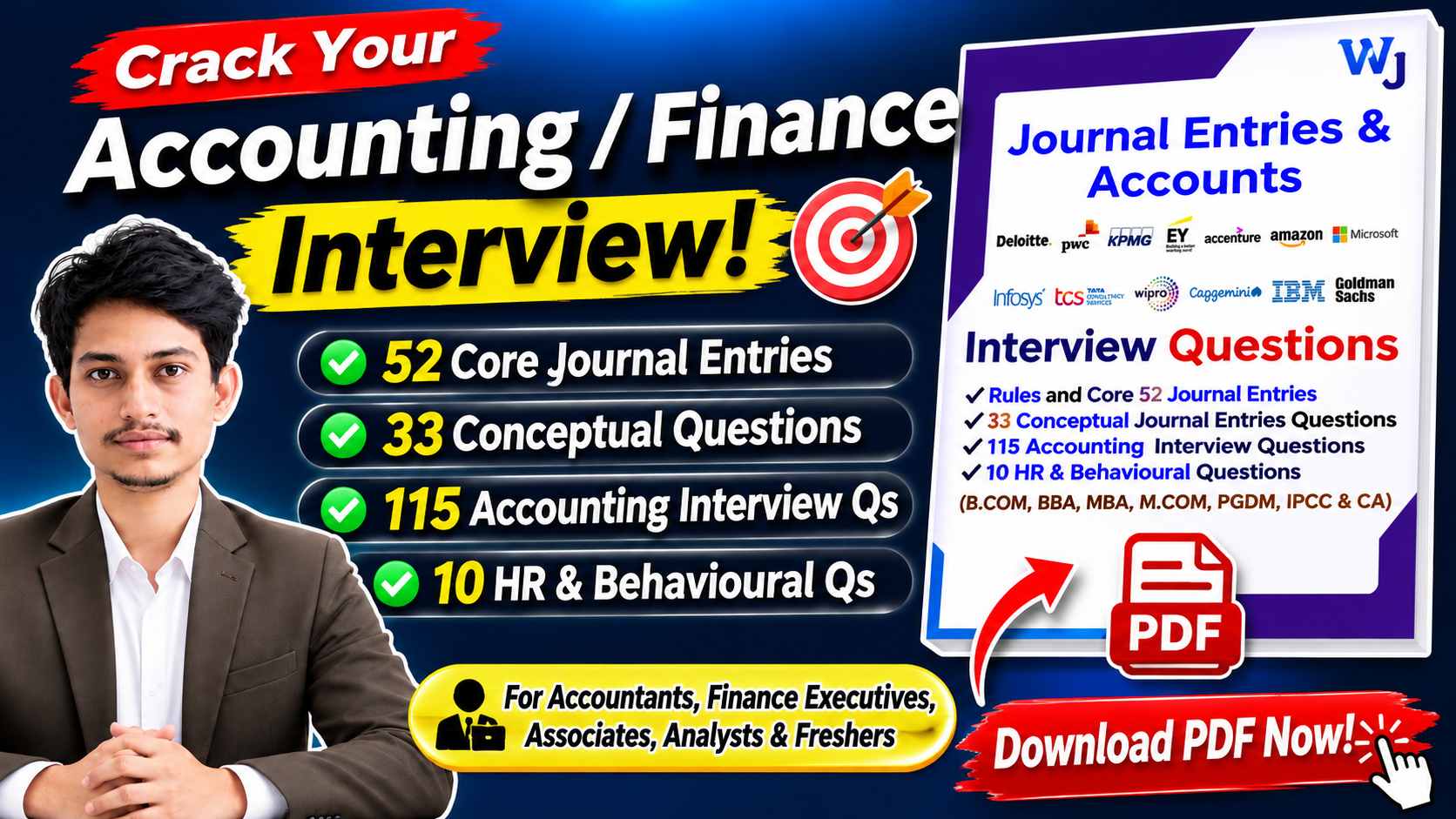
Journal Entries and Accounting Interview: Complete Preparation Guide
Preparing for journal entries and accounting interview questions? Understanding journal entries, debit and credit rules, financial statements, and accounting concepts is essential for answering technical interview questions confidently.
Whether you are a B.Com graduate, BBA student, MBA Finance candidate, M.Com graduate, CA aspirant, or an experienced accounting professional, strengthening your accounting fundamentals can help you prepare for a wider range of finance-related opportunities.
However, preparing for interviews can become difficult when questions, examples, and explanations are scattered across different websites and videos. A structured preparation resource can make revision more organized.
In this guide, we explore important journal entries, common accounting interview topics, and a preparation resource designed to help candidates revise these concepts.
What Are Journal Entries in Accounting?
A journal entry is the initial record of a financial transaction in the books of accounts. It identifies the accounts affected and records the corresponding debit and credit amounts.
Every journal entry follows the double-entry accounting principle, under which total debits must equal total credits.
For example, when a business pays ₹10,000 as office rent through its bank account, the transaction is recorded as:
Rent Expense A/c – Dr. ₹10,000
To Bank A/c – ₹10,000
Rent expense increases, so it is debited. The bank balance decreases, so it is credited.
Understanding this logic is more useful than memorizing entries without knowing why an account is debited or credited.
People also read: Gallagher and Mohan Accountant Interview
People also read: IQ-EQ Private Equity and Fund Accounting Interview Questions and Answers
Three Golden Rules of Accounting
The traditional accounting system uses three golden rules:
- Personal Account: Debit the receiver and credit the giver.
- Real Account: Debit what comes in and credit what goes out.
- Nominal Account: Debit all expenses and losses; credit all incomes and gains.
Under the modern accounting approach:
- Assets and expenses increase through debits and decrease through credits.
- Liabilities, capital, and revenues increase through credits and decrease through debits.
Candidates should understand both approaches because interviewers may ask questions about traditional accounting rules as well as modern debit and credit treatments.
Important Journal Entries to Prepare for Accounting Interviews
Journal entries are frequently used to assess whether candidates understand everyday business transactions and accounting adjustments.
Some important examples include:
1. Cash Sales
Cash / Bank A/c – Dr.
To Sales A/c
2. Credit Sales
Accounts Receivable A/c – Dr.
To Sales A/c
3. Credit Purchases
Purchase A/c – Dr.
To Accounts Payable A/c
4. Depreciation
Depreciation Expense A/c – Dr.
To Accumulated Depreciation A/c
5. Outstanding Expenses
Expense A/c – Dr.
To Outstanding Expenses A/c
6. Prepaid Expenses
Prepaid Expense A/c – Dr.
To Bank A/c
7. Bad Debts
Bad Debts Expense A/c – Dr.
To Accounts Receivable A/c
8. Deferred Revenue
Bank A/c – Dr.
To Deferred Revenue A/c
These examples cover common accounting situations involving sales, purchases, expenses, assets, receivables, and revenue recognition. Candidates should also understand how the entries affect the ledger and financial statements.
Common Accounting Interview Questions
Preparing journal entries alone is not enough. Accounting interviews can also test conceptual knowledge, practical problem-solving, and familiarity with accounting processes.
Here are some important questions candidates should practice:
- What is a journal entry in accounting?
- What are the key components of a journal entry?
- How do you decide which account to debit and credit?
- Explain the double-entry accounting system.
- What is the difference between a journal and a ledger?
- How do you correct errors in journal entries?
- What is a compound journal entry?
- What is a contra account?
- What is the difference between accounts payable and accounts receivable?
- How do you record depreciation?
- What is working capital, and how is it calculated?
- What is the difference between prepaid and outstanding expenses?
- How do you perform a bank reconciliation?
- What is deferred revenue?
- How are bad debts recorded?
Candidates should practice explaining the accounting treatment with examples rather than relying entirely on definitions.
What Does the Journal Entries and Accounting Interview Preparation PDF Include?
To make accounting interview preparation more structured, Winsome Ismail offers a dedicated Journal Entries & Accounts – Interview Questions and Answers PDF.
The guide includes:
- 52 Core Journal Entries: Practical accounting entries covering business commencement, sales and purchases, expenses, fixed assets, depreciation, bad debts, GST, TDS, inventory, customer advances, foreign exchange adjustments, and reconciliations.
- 33 Conceptual Journal Entry Questions: Questions designed to help candidates understand journal-entry fundamentals, debit and credit treatments, accounting principles, and transaction recording.
- 115 Accounting Interview Questions: A broader collection of technical accounting and finance questions.
- 10 HR and Behavioural Questions: Additional preparation for common non-technical interview discussions.
The practical journal-entry section also covers more advanced situations, including subscription revenue recognition, customer overpayments, credit-loss allowances, payment-processing fees, and foreign exchange revaluation.
This combination helps candidates revise basic accounting treatments alongside more detailed conceptual and practical questions.
Who Should Use This Accounting Interview Preparation Guide?
This resource is suitable for candidates from:
- B.Com and BBA backgrounds
- MBA Finance and M.Com programmes
- PGDM and commerce-related courses
- IPCC and CA backgrounds
- Freshers preparing for their first accounting interview
- Experienced professionals revising accounting fundamentals
It can be useful when preparing for opportunities such as Accountant, Accounts Executive, Accounts Payable Associate, Accounts Receivable Associate, Finance Associate, and other accounting or finance operations roles. Actual job requirements will vary by employer.
How to Prepare for an Accounting Interview Effectively
A PDF alone will not make you interview-ready. Use it as a study resource alongside practical exercises.
Step 1: Understand debit and credit rules. Learn how assets, liabilities, expenses, revenue, and capital behave when transactions occur.
Step 2: Practice journal entries. Write entries independently before checking the answers. Focus on the reason behind each debit and credit.
Step 3: Revise accounting concepts. Prepare topics such as working capital, reconciliations, financial statements, depreciation, and accounts payable and receivable.
Step 4: Practice explaining answers aloud. Interviewers assess how clearly you communicate accounting concepts, not just whether you can remember definitions.
Step 5: Prepare for HR questions. Be ready to discuss your education, experience, strengths, career goals, and approach to workplace challenges.
Download the Journal Entries and Accounting Interview Questions PDF
Strong accounting fundamentals can help you approach technical interview discussions with better preparation.
Instead of collecting random questions from multiple sources, use a structured resource to revise practical journal entries, conceptual accounting questions, technical interview topics, and HR questions.
Get the Journal Entries & Accounts – Interview Questions and Answers PDF by Winsome Ismail.
Explore the preparation resource here:
Visit Winsome Ismail – Interview Preparation PDFs
Prepare your concepts, practice your answers, and build a stronger foundation for your next accounting or finance interview.

Hello! I’m Ismail, founder and author of WinsomeIsmail.com & MyCareerPdf.com websites.
With an MBA and a strong passion for sharing knowledge, I create informative, value-driven content across multiple niches, including Blogging, Finance, SEO, Technology, and Career Development.
“Happiest are those who do the most for others.”
Feel free to explore my articles, and let’s connect!